// Bike histories · Garelli
In the autumn of 1919 a rider named Ettore Girardi pointed a Garelli 350 at Naples from Milan and did not stop for 840 kilometres, averaging 38.29 km/h. That ride is the first entry in a story that runs through a bicycle motor, a merger with a family of bicycle-part makers and, improbably, six consecutive world championships in the 1980s.

Adalberto Garelli was an engineer who patented a split-cylinder two-stroke, one combustion chamber fed by two pistons, a decade before Puch used the same technique. His company took shape in 1919, with production on viale Casiraghi in Sesto San Giovanni, outside Milan. The Milan to Naples run that autumn was the advertisement. The reputation was made by what came next: in one session at Monza in 1923 Garelli took 76 records, and in 1926 it grabbed 193 world records, a record of records. Then, in the late 1920s, it quietly ran down motorcycle production in favor of other engineering work.
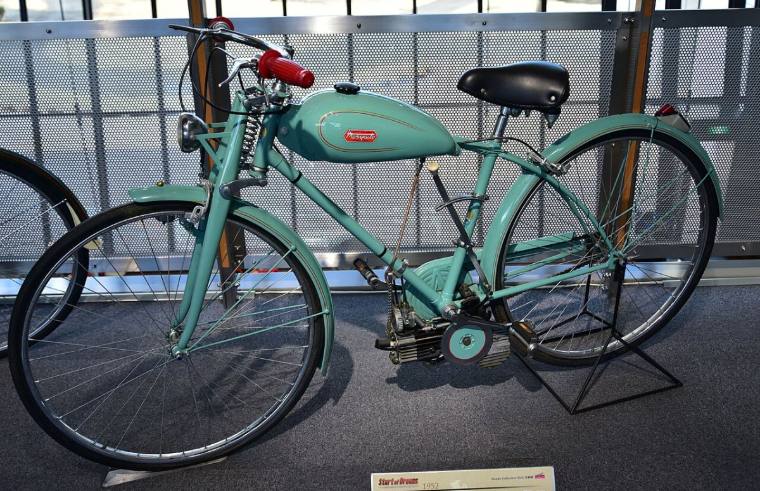
After the Second World War the factory was in ruins and the Italian army, its last big customer, was gone. What it built next sold to everyone. The Mosquito, first seen in 1946, is a small two-stroke that clamps to a bicycle frame and drives the tyre with a roller. It started at 38 cc, later grew to 49 cc, and eventually came as complete mopeds. Over about fifty years Garelli produced more than 1.5 million machines, counting motorcycles, mopeds and industrial engines, and the Mosquito sits at the center of that number.
In 1961 Garelli merged with Agrati, a family firm that had started in 1900 making electric motors and bicycles and was Italy's leading maker of bicycle parts. Agrati was already building the Capri scooter around a Garelli engine, so the marriage was less a takeover than a formalization. The two industrial complexes, Sesto San Giovanni for Garelli and Monticello for Agrati, kept turning out machines under the Agrati Garelli name.
Here is the weird part. A firm that most people knew as a moped brand then took over the 125 cc Grand Prix class. Under the team leadership of Daniel Agrati, Garelli returned to racing in 1982, and Ángel Nieto won the 125 cc world title that year, then again in 1983 and 1984. Fausto Gresini won in 1985, Luca Cadalora in 1986 and Gresini again in 1987. Garelli also won the constructors' title every one of those six years, and in 1983 it won the 50 cc constructors' title too.
The old habit never died. On 3 November 1963 two 50 cc Garelli machines set eight world long-distance records, proving that a factory known for bicycle motors could still run flat out for hours and finish.
The glory did not save the business. The factory closed for good in 1987, and by the 1991 Milan show Garelli had been taken over by Fantic and survived as a badge on bikes it no longer designed. It is a neat piece of Italian irony: the maker that gave bicycles an engine ended by giving its name to somebody else's.
Find your bike, then pick up something for the garage:
Related: Which Garelli do you have? Sport, SSXL, VIP and Monza GT by engine and frame number
General information from published sources and owner experience. Your bike, your state and your tools may differ, so check your own service manual and local rules. Moped Motel is an independent fan site, not a repair service. No seller, brand or channel mentioned here paid to be included or asked to be, and we have no affiliation with any of them.
More guides are on the Moped Wrench Guides page, with the sources. Want to meet the riders? See Feature Your Bike.
T-Shirts, hats, and customs. Checkout happens on Etsy.
Moped Motel is vintage two-stroke moped apparel. We print over 100 moped designs on t-shirts, long sleeves, hoodies, sweatshirts, hats and beanies, inspired by real Puch, Tomos and other classic mopeds. Everything is printed to order, and checkout is on Etsy.
// MOPED ARCADE
Name That Moped, Pinball, Blackjack and Stack. Free to play.
Play now