Bike histories · Hercules
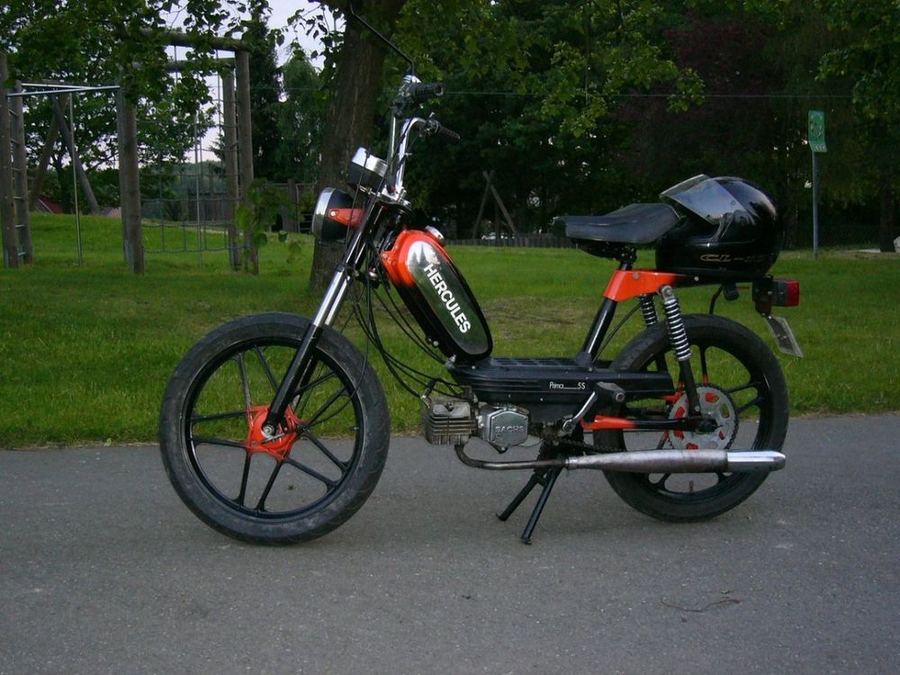
Hercules put one name on a pedal bicycle, a Mofa that sold for decades, a Wankel motorcycle and an electric moped riders ignored. In America the same Sachs-powered bikes changed names almost every year. Learn the names and the whole Hercules story stops being confusing.
Carl Marschütz started Hercules in Nuremberg in 1886 as a bicycle maker. By the mid-1890s it had 250 employees and turned out about 6,500 bicycles a year, and in 1897 it became a public company. Marschütz was Jewish. Under the Nazis he was forced to sell his shares far below their value, and he left for the United States. The bombed factories restarted bicycles in 1946 and motorbikes in 1949. Dresdner Bank sold the brand to Grundig in 1956, and Fichtel & Sachs, the Schweinfurt engine maker that already powered Hercules, took control not long after. The takeover stayed quiet for a few years so Sachs's other customers would keep buying its engines. That is why a Hercules moped is a Sachs engine in a Nuremberg frame, and why the same engine turns up under other badges.
Before the Prima there was the M series, the M1, M2, M4 and M5, with chrome fittings and spoked wheels that made a moped look expensive. Hercules renamed the line Prima in 1980 and kept building it into the 2000s. It is the most successful bike the company made. The base Prima is a Mofa: a 1.5 hp Sachs engine held to 25 km/h at the factory, with a two-speed manual gearbox on the 1, 3, 5 and 6 and a centrifugal automatic clutch on the 2 and 4. The GT, GX, SX and G3 trims add 1.6 hp, three speeds, an overhead fuel tank and a full-length seat. The Optima was the faster follow-on, a two-speed with 2.9 hp and a 50 km/h top speed from the factory. It looked almost like a Prima and sold far fewer. In the 1970s Hercules also built an electric moped, the E 1 Accu, and riders did not take to it.
Because the importer changed it. The 1975 to 1977 bikes were sold as Hercules by Sachs Motor Corporation of USA in Westlake, Ohio: a sheet-frame P1 and a tube-frame M4, mostly M4s, in 20 and 25 mph versions. In 1978 the P1 became the Westlake, named for the Ohio town where the importer sat, and the M4 became the Balboa, named for Balboa Island in Newport Beach, California. The mag-wheel Balboa turned into the Suburban in 1979, and in 1980 the Westlake became the Sundancer. The Seville, with oil injection, the Prima and the Prima G3 rounded out 1980. Sticker prices in 1981 ran Sundancer $665, Suburban $740, Prima $793, Seville $892, and about $993 for the G3. A dealer was still selling new 1980 Sundancers in 1984.
The same bike came out a third way in 1982 as the Eagle, built for Bombardier of Canada with the Sachs logos taken off. The H stayed on the gas cap and the headlight brackets. Eagles sold mostly in Minnesota, Wisconsin, Illinois and Michigan, and almost none reached California. The Sachs Eagle page covers that bike on its own.
Sachs had the rotary engine and Hercules had the dealers. The W-2000 of 1974 was the first Wankel motorcycle offered to the public, with an air-cooled single-rotor Sachs engine of 294 cc, a fan up front and 23 to 32 hp. Oil went in with the fuel until the 1976 W-2000 Injection added an oil pump, a front disc brake and 18 inch wheels. In Britain it wore a DKW badge. A rotary dirt bike, the KC-30, followed in 1975 and failed to sell at $2,900. The Sachs rotor also gave a BSA engineer the starting point for the twin-rotor in the Norton Classic. None of it touched the moped line, which kept selling Prima and M series bikes at a fraction of the price.
Cheap Japanese 50 and 80 cc scooters such as the Honda Spree and Elite and the Yamaha Razz and Riva took the American market, helped by stricter licensing and registration and cheaper gasoline. Hercules stopped supplying US bikes in the early 1980s, and Sachs engines went on arriving for other badges until the last one shipped in 1990. The last US bike with a real Sachs 505/1D was the KKM Mopet, built in Ohio from 1988 to 1990. In Germany the Prima and its relatives went on into the 2000s, which made Hercules the last German company building mopeds. The name survives on bicycles.
Ignore the tank badge and read the cylinder. A stamp of 25km or 40km tells you what the engine was built for, and the 1A, 1B and 1D codes give the American speed. An American bike has side reflectors and bigger lights, a European import has neither, so a Prima from Germany arrives without the lighting a US bike carries. For a first Hercules, buy a Prima: cheap, simple, chrome-trimmed and a long-time favorite for tuning. Pick a Balboa or Suburban if you want the American paperwork and the tube-frame M4 underneath. The engine side of the story is in the Sachs 505 piece.
Meet the rest of the family, then pick up something for the garage wall or the rider.
Related: The German Mofa and its 25 km/h paper trail
General information from published sources and owner experience. Your bike, your state and your tools may differ, so check your own service manual and local rules. Moped Motel is an independent fan site, not a repair service. No seller, brand or channel mentioned here paid to be included or asked to be, and we have no affiliation with any of them.
More guides are on the Moped Wrench Guides page, with the sources. Want to meet the riders? See Feature Your Bike.
T-Shirts, hats, and customs. Checkout happens on Etsy.
Moped Motel is vintage two-stroke moped apparel. We print over 100 moped designs on t-shirts, long sleeves, hoodies, sweatshirts, hats and beanies, inspired by real Puch, Tomos and other classic mopeds. Everything is printed to order, and checkout is on Etsy.
// MOPED ARCADE
Name That Moped, Pinball, Blackjack and Stack. Free to play.
Play now