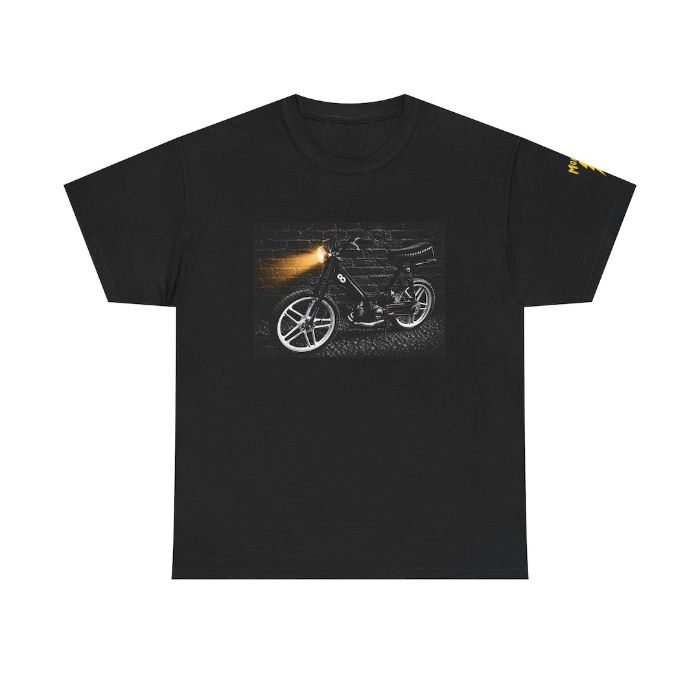
Aalst, Belgium. 49cc air-cooled two-stroke. Automatic, single speed, pedal start.
The Hobbit is a Belgian bike wearing a Japanese badge, and that is the whole trick of it. Honda's first factory outside Japan did not build a scooter or a big motorcycle for America. It built a pedal moped for Europe, then shipped the same machine across the Atlantic under a new name.
Honda sent a team of twelve to Belgium in May 1962 to start a subsidiary, and the plant at Aalst grew into the company's first production site outside Japan. The first machine off its line was the Super Cub. Europe had wanted pedal-assisted mopeds since the 1950s, so Aalst soon added a pedal model of its own, the C310.
Around 1975 the name on the door changed from Honda Belgium to Honda Benelux, because parts were now coming from the Netherlands and Luxembourg too. The PA50 came out of that operation in 1976. US Honda dealers sold three pedal mopeds in all: the P50, the PC50 and the PA50. The four-stroke P50 and PC50 lasted a year or two each. The two-stroke PA50 stuck around.
The same machine was the Camino in the UK and the rest of Europe from 1976 to 1991, and the Hobbit in the US from 1978 to 1983. The Camino's model codes read like a puzzle: L for basic, V for the Variomatic transmission, C for chrome fenders and indicators, S for sport, DX for deluxe, M for a 25 km/h limit.
The earliest Camino L had a V-belt drive and almost no electrics, with no battery and no indicators. Later ones added the Variomatic, a basket, cast alloy wheels and a round headlamp with a separate speedometer on the Sport. The last of the line, the VCH, ran from September 1986 to June 1991. Different countries got different speed versions to fit their laws.
The engine is a 49cc air-cooled two-stroke single with a 39.6 mm bore and 6.7:1 compression. It drives through an automatic clutch and a single-speed continuously variable transmission, which means one automatic gear and nothing to shift. The backbone frame carries a telescopic front fork with 65 mm of travel and a pivoting rear fork with 150 mm. Both brakes are drums. Dry weight is 45 kg, about 99 lb. You pedal to start it.
America got two versions. The PA50 I topped out around 20 mph and was sold in states with a 20 mph moped limit. The PA50 II reached about 30 mph. The PA50 I was dropped in 1980, which leaves the PA50 II as the bike most people mean when they say Hobbit. Early PA50 I bikes came in red and white in 1978 and red and black in 1979, with a PA50I/PA50M sticker, though the paint is not a perfect guide.
The two do not differ in displacement. The speed comes from how much the engine can breathe. The PA50 II runs a number 78 main jet where the PA50 I runs a number 60, a reed with two smaller slots where the PA50 I has one, and larger air intake holes and exhaust. Owners who want a PA50 I to behave like a PA50 II enlarge the three air holes ahead of the filter, upgrade the carburetor and fit the PA50 II reed. In Europe, speed versions were set mainly by the strength of the CVT springs.
The final version arrived in 1983 and was unchanged apart from cosmetics and a more comfortable seat. The Hobbit left the US market that year. It has mostly disappeared from American and British streets, but in Belgium it never went away. Belgian owners still ride them, and they modify them hard with high-performance parts.
Related: Honda Spree: the $398 scooter that wore a different name on every continent.
Got a wrench in your hand? The Moped Wrench Guides cover tools, buying, tires and more.
T-Shirts, hats, and customs. Checkout happens on Etsy.
Moped Motel is vintage two-stroke moped apparel. We print over 100 moped designs on t-shirts, long sleeves, hoodies, sweatshirts, hats and beanies, inspired by real Puch, Tomos and other classic mopeds. Everything is printed to order, and checkout is on Etsy.
// MOPED ARCADE
Name That Moped, Pinball, Blackjack and Stack. Free to play.
Play nowRelated: Honda PA50 engine: how to tell a PA50-I from a PA50-II