Bike histories · Sparta
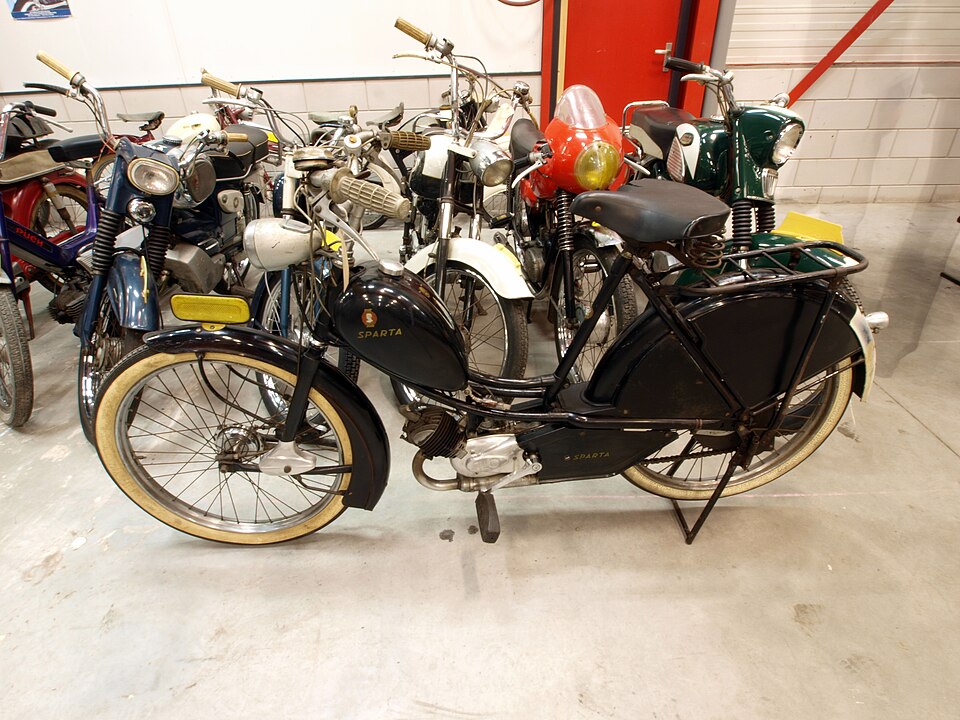
Sparta is the Dutch moped that started life as a bicycle and never quite stopped being one. The Apeldoorn factory built the pressed-steel M-series in the 1950s, the Sachs-powered Buddy and Lucky in the 1970s, and closed its engine business with the Spartamet, a bicycle with a small motor. Here is the line, who drew it, and which ones reached America.
Two wholesalers, A. Verbeek and D.L. Schakel, started selling bicycles and parts on the Hoofdstraat in Apeldoorn in September 1917. That year they bought the Sparta, Romein and Vaandel brand names. By 1920 they were building their own bicycles, Schakel bought Verbeek out in 1925, and in 1927 the firm moved into a new factory on the Waterloseweg.
The first motorised Sparta came in 1931, a bicycle with a small Sachs two-stroke. Villiers and JLO engines followed through the 1930s. After the war Sparta built real motorcycles on Villiers power, and by 1951 it was out-selling Norton in the Netherlands.
Jan Wilke. Sparta hired him in the late 1940s, and his first job was a telescopic front fork and plunger rear suspension for the motorcycles. When the motorcycle market collapsed in the mid-1950s, Sparta put its effort into mopeds, and Wilke’s answer was a pressed sheet-metal frame in 1955. He stayed until 1980, and his team of about ten people drew nearly every Sparta moped.
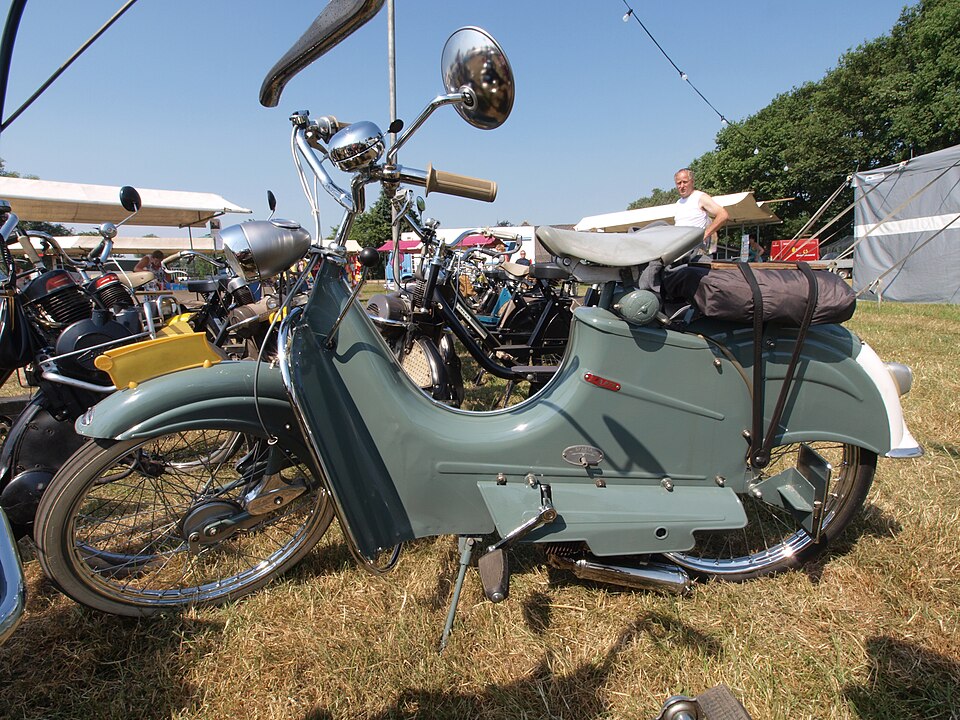
The MA50, first sold in 1958, is the one nicknamed the nurses’ moped. The MB50 was a 1959 facelift, and the MC50 of 1962 was the last of the M-series. Before it came the GB50 of 1957 with a 49 cc JLO engine, and after it came dual-seat sport models without pedals: the GF50 SS in 1962, the GG50 Sport in 1963 and the GH50 Grand Sport in 1964, again on JLO power. The Tour Moped ran from 1964 to 1971 and the Spartamatic from 1966 to 1969. Output peaked in 1965 at roughly 47,000 machines and about 380 workers.
A Sachs 504/1A. The Buddy carries its fuel tank up front and the Lucky carries it behind the seat. Both came in a 45 km/h version and a 25 km/h version, so read the engine before you order parts or quote a top speed: one frame hides two different bikes. Dutch Buddies date from 1973, and the Lucky followed in the mid-1970s. Ignition changed from Bosch on the 1976 to 1978 bikes to Motoplat on the 1978 to 1980 bikes, which is a useful way to date a loose engine.
Exports to the US lifted Sparta sales between 1977 and 1980, and they faded after 1980. The bikes came in through several importers under different names. Sparta, Inc. of Wilmington, Massachusetts sold the Standard and the Deluxe in 1976 and 1977 and added the Stingray scooter in 1978. Flying Dutchman Moped and Bicycle of Glendale, California, run by Ted Van Der Kolk, sold Sparta-built Flying Dutchman mopeds from 1977 to 1980; a Flying Dutchman is a Lucky with another name on it, rear tank included.
United Moped of Fountain Valley, California listed the Foxi GT at $649 and the Foxi GT Sport at $695. By 1980 and 1981 the price lists belonged to Dusor USA of Stamford, Connecticut, with the Buddy at $660 and the Deluxe at $725, and to Moby/Sparta of Chelmsford, Massachusetts, with the Buddy at $699 and the Deluxe at $725. Foxi was also a KTM name, so confirm the frame is Dutch before you pay for one.
Moped production wound down in the early 1980s, and Wilke retired in 1980 after 31 years at the factory. Sparta kept an engine in the catalogue through the mid-1980s with the Spartamet, a bicycle with a Sachs-built motor that sold until about 1999. In 1990 roughly one in five Sparta bicycles was a Spartamet. On 28 September 1999 Sparta announced it was joining Accell Group, the same group that owns Batavus, and today the name sits on e-bikes.
If you want a bike that was sold new in America, buy a late-1970s Buddy or a Flying Dutchman. They carry the Sachs 504/1A, they have a US price history, and the engine tells you which speed version you have. If you want the good-looking one, hunt an M-series: the nurses’ mopeds date from years before any of Sparta’s American importers. The GB50 and the 3V are already in the library. Skip any Foxi until you have checked the frame.
Look at Sparta’s sister brand and the Sachs engines behind the later bikes, then pick up something for the garage wall or the rider.
Related: Batavus: the Dutch clock store that became a moped giant, then sold Americans the Starflite
General information from published sources and owner experience. Your bike, your state and your tools may differ, so check your own service manual and local rules. Moped Motel is an independent fan site, not a repair service. No seller, brand or channel mentioned here paid to be included or asked to be, and we have no affiliation with any of them.
More guides are on the Moped Wrench Guides page, with the sources. Want to meet the riders? See Feature Your Bike.
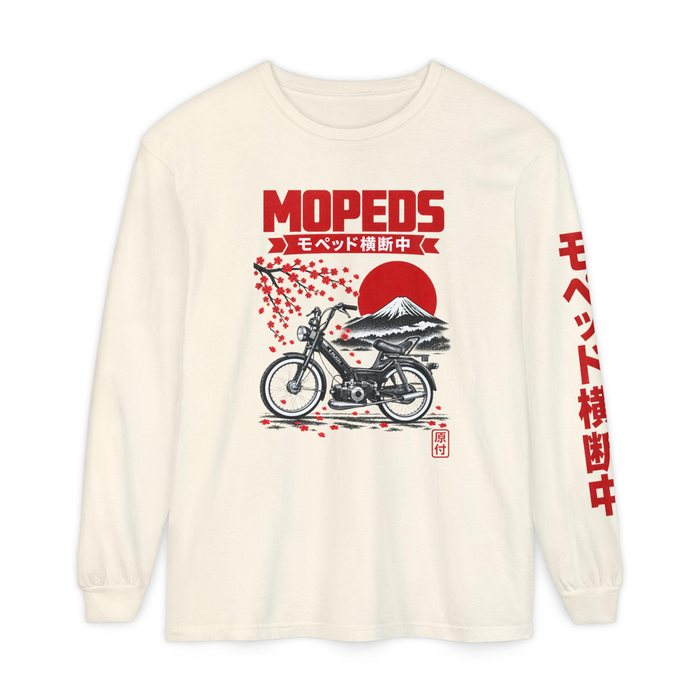
T-Shirts, hats, and customs. Checkout happens on Etsy.
Moped Motel is vintage two-stroke moped apparel. We print over 100 moped designs on t-shirts, long sleeves, hoodies, sweatshirts, hats and beanies, inspired by real Puch, Tomos and other classic mopeds. Everything is printed to order, and checkout is on Etsy.
// MOPED ARCADE
Name That Moped, Pinball, Blackjack and Stack. Free to play.
Play now