Engines of Note · The sixteener loophole
Until late 1971 a sixteen-year-old in Britain could put on L plates and ride a 250. Then the government counted the injuries and changed the rule. Sixteen got you a moped and nothing bigger, and the big bikes waited for seventeen. The law was meant to put teenagers on something gentle. It put them on the fastest fifties ever built.
Two lines. A machine not exceeding 50 cc, fitted with pedals that could propel it. No speed limit, no power limit, no weight limit. The people who wrote it were picturing the NSU Quickly and the Raleigh Runabout, sedate step-throughs for sedate first-timers. They defined a moped by its engine size and its pedals, then left the room. Nobody asked what a factory could fit under 50 cc.
They added pedals. From 1972 Honda, Yamaha, Suzuki, Puch, Fantic, Garelli, Gilera and Gitane sold 50 cc sports bikes that looked like small motorcycles because they were small motorcycles, with a set of pedals bolted on as the price of admission. Yamaha did it best. The FS1 was already a hit in the Netherlands; for Britain it got pedals, a four-speed gearbox and an E for England on the end of its name. The 49 cc two-stroke with a rotary disc valve made 4.8 bhp, enough for 50 mph in standard trim and 60 or more with a tuner's attention. Around 200,000 Fizzies were sold in Britain, and the 1975 FS1-E D listed at £199, about £1,600 at current prices.
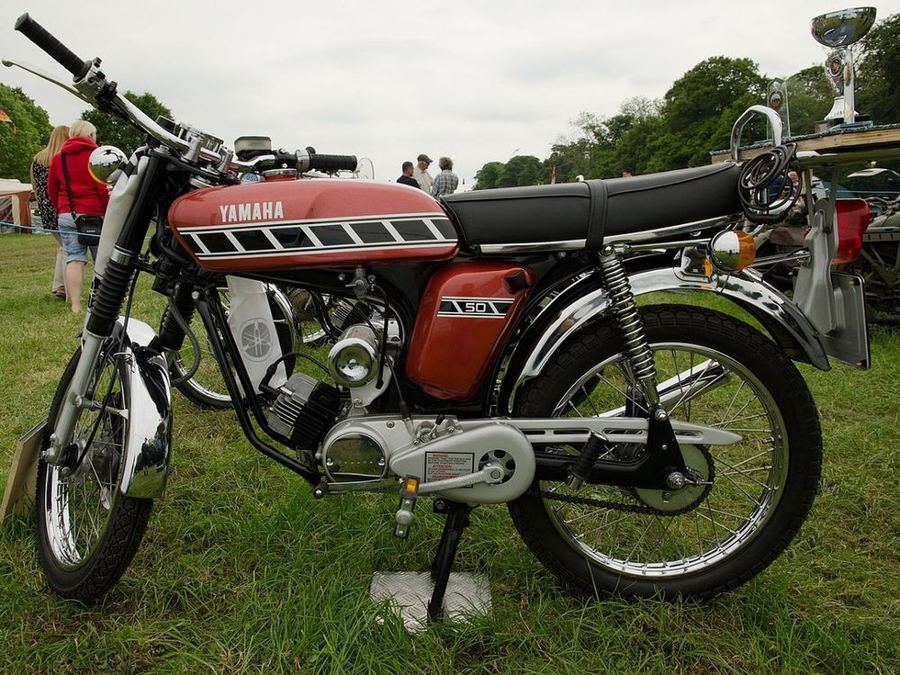
The rest of the grid was just as committed. Fantic built a chopper in the image of Captain America's Harley, with a 49 cc two-stroke and pedals. Garelli's Tiger Cross carried pedals and low-slung footrests at the same time. Honda's SS50 was the four-stroke of the group, 2.5 bhp and four gears at first, 4 bhp and five gears later. Suzuki's AP50 arrived in 1976 with 4.8 bhp and five gears and was quicker than the Fizzy. Puch's M50 Sport, built in 1973 and 1974, ran a 48.8 cc engine making 2.6 hp through a Bing carburettor, with four speeds and a pedal starter, on 17-inch wheels.
Nothing. Owners locked them in place and used them as footpegs, and on some bikes a cotter pin let a crank swing through 180 degrees and lock. They were never meant to turn. Teenagers modified them, and an aftermarket grew up around the parts. The tuning went further. A maker's restrictor was the first thing to come out and a bigger carburettor was next: a Fantic TI left the factory with 6.5 bhp through a 14 mm Dell'Orto and made 7.2 bhp with a 19 mm kit. Some owners went past the engine size too, with big-bore kits that raised displacement beyond 50 cc.
On 1 August 1977 the moped class was redefined with a design speed limit of 30 mph, and the pedal requirement was deleted. The law that made every fast fifty carry pedals in 1971 took them away in 1977, because by then everyone could see what the pedals were. Demand dropped fast. The last unrestricted stock cleared out of the dealers, and the Fizzy ran on until production stopped in 1983. Sports mopeds came back in the 1980s as the Kawasaki AR50, the Honda MBX-50 and the Yamaha RD50, a different breed built to a different rule.
An unrestricted bike from the window between 1972 and 1977, with the pedals still on it. A decent FS1-E starts around £2,500, and a minter with matching engine and frame numbers can double that, so read the numbers before you admire the paint. Keep the pedals on anything you restore. They are the reason the bike exists.
Find your bike, then pick up something for the garage wall or the rider.
General information from published sources and owner experience. Your bike, your state and your tools may differ, so check your own service manual and local rules. Moped Motel is an independent fan site, not a repair service. No seller, brand or channel mentioned here paid to be included or asked to be, and we have no affiliation with any of them.
More guides are on the Moped Wrench Guides page, with the sources. Want to meet the riders? See Feature Your Bike.
T-Shirts, hats, and customs. Checkout happens on Etsy.
Moped Motel is vintage two-stroke moped apparel. We print over 100 moped designs on t-shirts, long sleeves, hoodies, sweatshirts, hats and beanies, inspired by real Puch, Tomos and other classic mopeds. Everything is printed to order, and checkout is on Etsy.
// MOPED ARCADE
Name That Moped, Pinball, Blackjack and Stack. Free to play.
Play now