Bike histories · VéloSoleX
The firm behind the VéloSoleX never set out to build a bicycle. It made radiators, then carburettors, and then, with a war on, a motor you could hang over a front wheel. The result sold in the millions and looks like an engineer's dare, which is exactly why people love it.
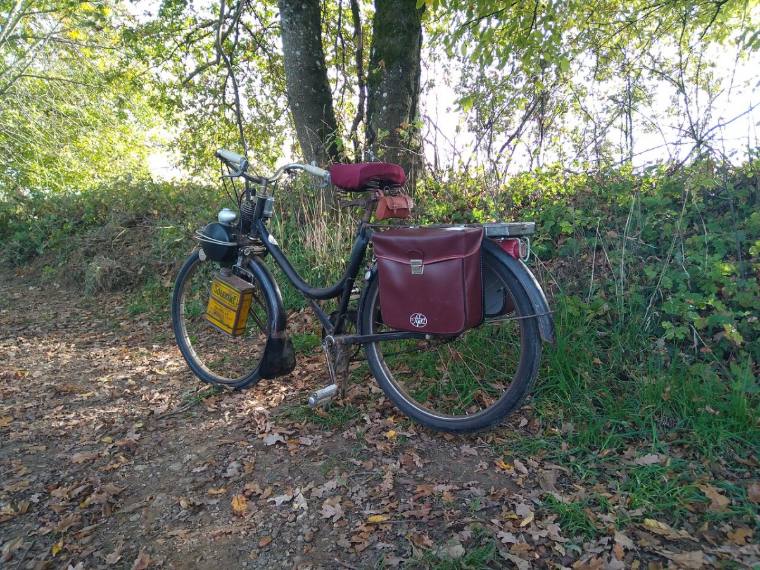
Marcel Mennesson and Maurice Goudard met at the École Centrale in Paris and went into radiators in 1905. When the radiator trade sagged after the First World War, they bought a set of carburettor patents and stamped the company name on the product. Solex became a carburettor brand first and a bicycle second, which is the reverse of how most moped stories run. The carburettor was good enough that Mikuni licensed it in 1960, and Solex units stayed on engines until fuel injection arrived in the mid-1980s.
In the early 1940s, under the German occupation, the firm built a prototype: a 38 cc two-stroke on an Alcyon bicycle frame, with a roller pressing on the front tyre. The paper trail disagrees on whether that was 1940 or 1941. The machine itself was not in doubt.
Everything. A 49 cc air-cooled two-stroke sits above the front wheel, and a roller on its output presses against the tyre and turns it by friction. No chain, no belt, no gearbox. The carburettor has no float, and a diaphragm pump driven by crankcase pressure moves the fuel. A flywheel magneto makes the spark and runs the lights.
The first production model displaced 45 cc and had no clutch, so every stop meant a restart. Wet roads and worn tyres made the roller slip. There was no stand and no easy way to disengage the drive. A 1951 update added a centre stand and a lever that lifts the engine off the wheel, which tells you how many owners had already asked.
Production began at the end of April 1946, and the machine stood at the Auto and Cycle show in the Grand Palais that year. The launch advertising promised 100 km on under a litre of fuel. A London road test in 1949 turned the promise into numbers: 205.5 miles per gallon, a top speed near 16 mph, a weight of 58 lb and a price of about 48 pounds with purchase tax. In France in 1948 it cost 19,418 francs.
It even had its own fuel. In 1947 BP began selling a premixed blend of 94 percent petrol and 6 percent oil, called Solexine, in yellow two-litre cans. By 1962 more than a thousand French stations stocked it. A machine that needs its own brand of gasoline has stopped being an accessory and become a habit.
By making it the cheapest way to stop pedalling. The factory had built 117,020 engines by January 1951 and 254,685 by January 1953. The total ended somewhere between seven and eight million, with licensed builders from The Hague to Geneva to Turin.
The line kept moving. The 330 of 1953 was a 49 cc machine. The 1700 of 1959 got a centrifugal clutch. The 2200 arrived in 1961, the 3300 in 1964 with a rectangular-tube frame and a rear drum brake. Then came the 3800 in May 1966, which stayed in production until November 1988. That is the longest run in the range and the shape most people picture when they say Solex. It also had screen time: it carries Jacques Tati's character through Mon Oncle in 1958 and turns up in Three Days of the Condor in 1975.
The 3800 was sold in the United States from 1967 to 1974. The 4600 followed in 1974, built for export with the American market in mind, and the US and Canadian version ran through 1976. In December 1974 Renault passed moped production to Motobécane, so the last American Solexes were Motobécane-era bikes wearing the old name.
French production ended at Saint-Quentin on 7 November 1988. Licensed builds carried on in Hungary into the 2000s, and the name later returned on an electric bicycle. The original idea outlived the company that had it.
If you want one to ride, find a 3800. It has the longest production run, so it has the best odds of turning up for sale, and it has the proportions everyone expects. If you want the original, hunt the 45: no clutch, a restart at every stop and a roller that does all the thinking. On any of them, look at the tyre under the roller before you look at anything else, and do not plan on riding in the wet. The full model list is on the VéloSoleX page in the Moped Library.
Meet the rest of the family, then pick up something for the garage wall or the rider.
General information from published sources and owner experience. Your bike, your state and your tools may differ, so check your own service manual and local rules. Moped Motel is an independent fan site, not a repair service. No seller, brand or channel mentioned here paid to be included or asked to be, and we have no affiliation with any of them.
More guides are on the Moped Wrench Guides page, with the sources. Want to meet the riders? See Feature Your Bike.
T-Shirts, hats, and customs. Checkout happens on Etsy.
Moped Motel is vintage two-stroke moped apparel. We print over 100 moped designs on t-shirts, long sleeves, hoodies, sweatshirts, hats and beanies, inspired by real Puch, Tomos and other classic mopeds. Everything is printed to order, and checkout is on Etsy.
// MOPED ARCADE
Name That Moped, Pinball, Blackjack and Stack. Free to play.
Play now