Engines of Note · Peugeot 103 in Morocco
The Peugeot 103 entered French production in 1971 and left it in 2011. Morocco kept building it for three more years, in a plant at Aïn Sebaa in Casablanca, and the bike never really left. A new one cost 1,400 dirhams in 1991 and 7,400 dirhams in 2017.
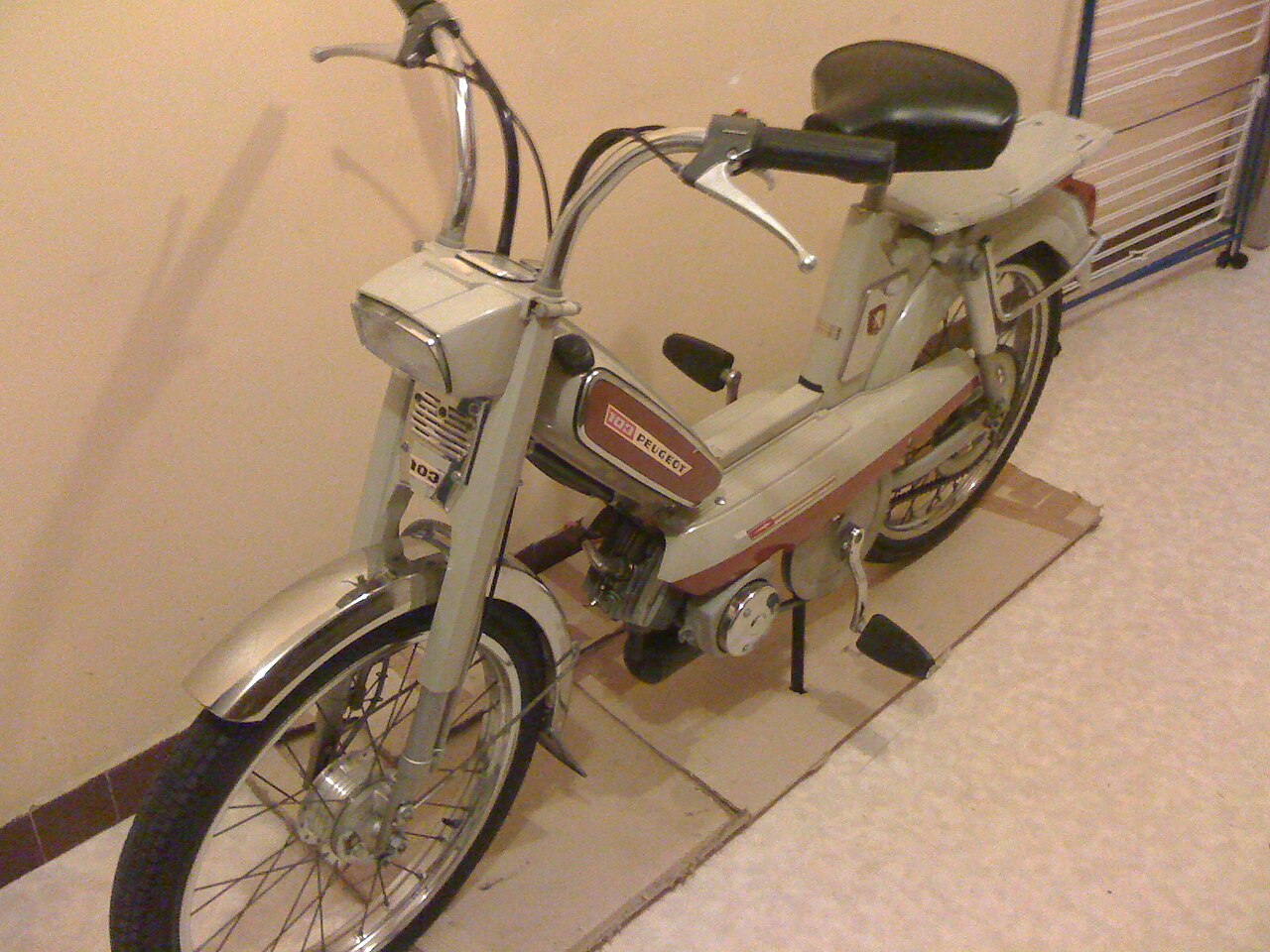
Peugeot launched the 103 in France in 1971 to replace the 101 and 102, a 49 cc two-stroke pitched at older riders in the countryside. Moroccans began importing it in the 1980s. Local assembly followed at Aïn Sebaa, in Casablanca, under the DIMAC-Peugeot Motocycles name. One account puts Moroccan production ten years after the French start, which would be 1981, while another says only that imports began in the 1980s. The decade is safe. The exact year is not.
The factory passed through three owners on paper: the SNI group in 1974, ONA in 1989 and CFAO in 1991. The product never changed hands. It stayed a 49 cc machine with a 45 km/h ceiling, and as of 2017 a rider needed no licence to use one.
In 1991 the sticker read 1,400 dirhams. By 2017 the catalogue held seven models, with the orange Classic at 7,400 dirhams and the dearest version past 10,000. In nominal dirhams that is more than five times the 1991 price across twenty-six years. French press converted the range to roughly 700 and 1,000 euros.
The reported top price differs by outlet, 10,300 dirhams in one and 10,600 in another, so treat the ceiling as approximate and the 7,400 floor as the figure to trust.
The model names tell you what buyers wanted: Classic, Clip, Sport, Fox, Ninja. The Ninja alone took half of all sales.
Annual sales peaked at 18,000 in 2009 and settled near 12,000 a year after that, with an average near 14,000. By 2013 roughly 200,000 were on the road. Those are factory figures from the final years of production. They explain why a bike that left French production in 2011 was still the default Moroccan moped long after, and why the closure three years later removed a line that had been selling by the thousands every year.
France stopped in 2011. Morocco followed three years later, in 2014, when the Casablanca plant closed. By 2017 Chinese scooters had been pouring into the country for about a decade, and a Turkish copy called the Ramzey was on sale. The reporting names no single cause for the closure. It records the sequence: France stops, scooters arrive, the Casablanca line goes quiet.
Mohammed Ngaire, 63, sells used bikes at the market in Rabat. He called the Chinese scooters disposable razors, and he said Moroccans adore the 103.
A week-long raid every May, the Guidon Mob Tour, takes riders from Essaouira to Agadir on 103s. The used market in Rabat sits in the L'Océan quarter, and that is where buyers go for a bike that is no longer built in the country.
The engine details, bore and stroke and the 55 on the speedometer, are on the Peugeot 103 engine page. This page is about what a plant, a price list and a 45 km/h law did to one engine in one country.
Find your bike, then pick up something for the garage wall or the rider.
General information from published sources and owner experience. Your bike, your state and your tools may differ, so check your own service manual and local rules. Moped Motel is an independent fan site, not a repair service. No seller, brand or channel mentioned here paid to be included or asked to be, and we have no affiliation with any of them.
More guides are on the Moped Wrench Guides page, with the sources. Want to meet the riders? See Feature Your Bike.

T-Shirts, hats, and customs. Checkout happens on Etsy.
Moped Motel is vintage two-stroke moped apparel. We print over 100 moped designs on t-shirts, long sleeves, hoodies, sweatshirts, hats and beanies, inspired by real Puch, Tomos and other classic mopeds. Everything is printed to order, and checkout is on Etsy.
// MOPED ARCADE
Name That Moped, Pinball, Blackjack and Stack. Free to play.
Play now