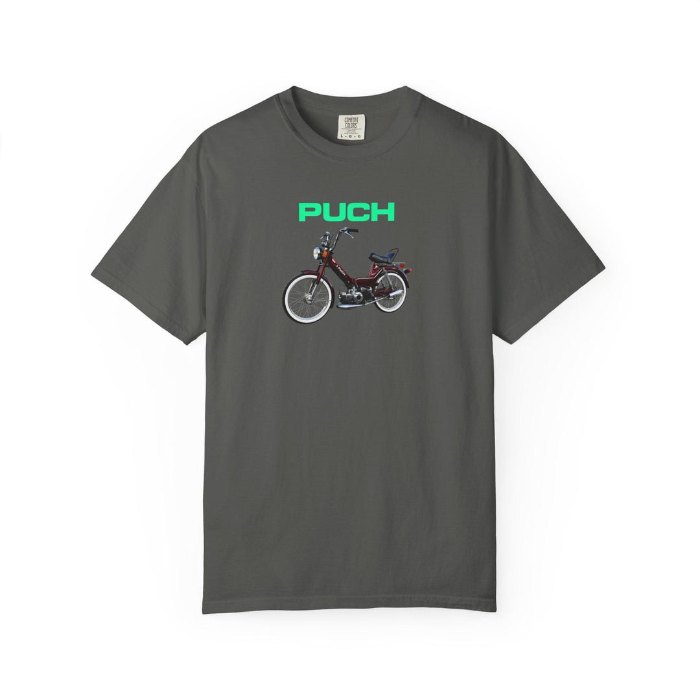
Graz, Austria. 49cc air-cooled two-stroke. One- or two-speed automatic, later kick-start.
The Maxi is what happens when a factory builds one machine so well that the rest of its range turns into a footnote. It launched in 1969, stayed on sale for more than two decades, and about 1.8 million were built.
The Maxi found its audience in the 1973 oil crisis, when a bike that claimed up to 120 mpg stopped looking like a toy. It had a name for being reliable and easy to maintain, and it had a pedal-start moped's best trick: the engine could be disengaged so the bike rode like a bicycle. Puch built it from 1969 to 1990, and Piaggio kept it going from 1991 to 1995. Aftermarket parts are still widely available.
It is a 48.8cc air-cooled two-stroke with a 38 mm bore and 42 mm stroke, making 0.8 kW at 4,000 rpm. The tank holds 3.2 liters. Early bikes pedal-start and later ones kick-start.
Three gearbox arrangements carry the Maxi name. The E50 is a single-speed automatic with a round gearbox and one centrifugal clutch, which engages and disengages on its own with engine speed. The ZA50 is a two-speed automatic with a rectangular gearbox and two centrifugal clutches, one per gear, and it shifts itself according to engine speed and road speed. The Z50 is a two-speed you shift by hand. The engine number is stamped on top of the right crankcase. The owner's manual has a tip worth keeping: once you reach top speed, back the throttle off to about three-quarters. Speed barely changes and fuel use falls.
Puch sold the same engine in three power ratings: 1.0 hp for 20 mph, 1.5 hp for 25 mph and 2 hp for 30 mph, so one bike could fit the law in whichever state or country it landed. The only marking was a sticker on each side cover that named the power version. Lose the stickers and you identify the version by measuring parts against a chart. Plenty of owners de-restrict a bike by opening the airbox, carburetor, manifold and pipe, or by fitting aftermarket parts.
The range branched fast. The Maxi S has full suspension and the E50. The Maxi D, or LS, adds a longer seat for a passenger. The Luxe brings a Hi-Torque head and mudflaps. The Maxi N has a rigid frame and no speedometer, the cheapest of the lot, nicknamed the poor man's Maxi. The Sport MKII has mag wheels, the ZA50 and a long solo seat.
Then come the oddities. The Maxi Nostalgia was a 1976 black and gold special with decals based on Puch's turn-of-the-century logo. The Maxi BMX Special, a 1976 tribute to Puch's BMX bicycles, lasted three months because buyers did not take to it. The Newport is a Maxi S with different decals, hand pinstriping and reflective whitewalls. The Newport L swapped the pinstripes for swoop decals and a puffy saddle, the Auto-start added metallic paint, oil injection and no clutch lever, and the Newport II used the ZA50.
Mint Maxis are collectible and parts are easy to find. Real sold prices are in the vintage moped price guide. The Puch Maxi page has the quick facts and the T-Shirts.
Got a wrench in your hand? The Moped Wrench Guides cover tools, buying, tires and more.

T-Shirts, hats, and customs. Checkout happens on Etsy.
Moped Motel is vintage two-stroke moped apparel. We print over 100 moped designs on t-shirts, long sleeves, hoodies, sweatshirts, hats and beanies, inspired by real Puch, Tomos and other classic mopeds. Everything is printed to order, and checkout is on Etsy.
// MOPED ARCADE
Name That Moped, Pinball, Blackjack and Stack. Free to play.
Play now