Engines of Note · Puch E50
The Puch E50 is the single-speed, air-cooled two-stroke of about 49 cc under roughly 1.8 million Puch Maxis, and Johann Puch never saw one. He died in 1914. The engine came 55 years later.
Puch (1862 to 1914) sold Humber bicycles in Graz before he built his own. Johann Puch & Co. started in 1890 with 34 workers. He left in 1897 after a dispute with his partners, and in 1899 founded the Erste Steiermärkische Fahrradfabrik at Puntigam, south of Graz. Engines followed in 1901, cars in 1904. Puch merged with Austro-Daimler in 1928 and with Steyr in 1934 to form Steyr-Daimler-Puch.
The Maxi arrived in 1969. A stamped frame doubles as a 3.2 L tank, the dry weight is about 40 kg, the carburetor is a 12 mm Bing, and the mileage can reach 120 mpg. It took hold during the 1973 oil crisis, and in 1978 Puch built over 270,000 mopeds and motorcycles and 350,000 bicycles. About 1.8 million Maxis came off the line.
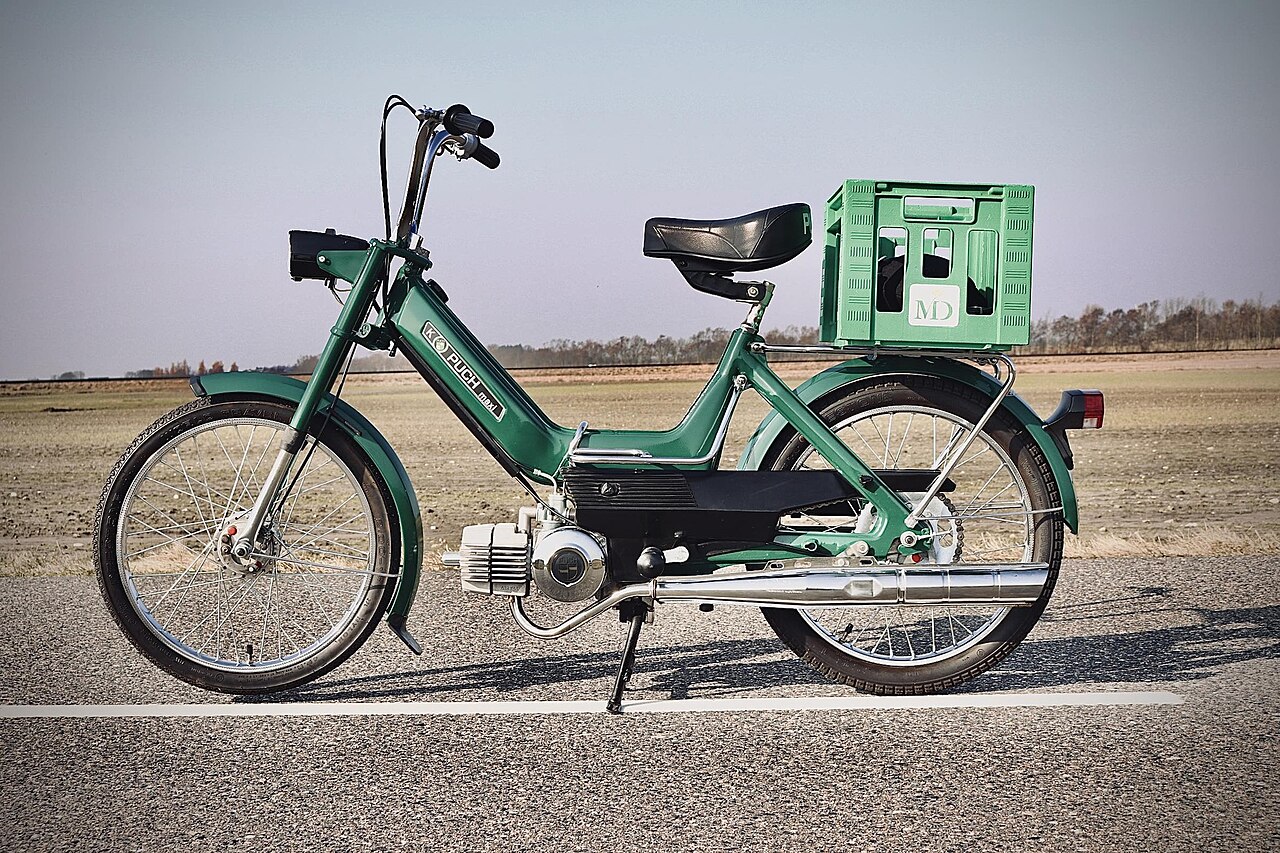
One centrifugal clutch, one gear, and a round cover on the right side. The two-speed ZA50 has a rectangular cover and two clutches, one per gear. Displacement is 48.8 cc. The E50 holds about 170 cc of ATF Type-F, against 280 cc in the ZA50, and the oil wants changing every 3600 miles. A pedal-start bike starts by pedaling or by spinning the flywheel with a drill after the clutch cover comes off. Kickstart came later.
At up to 120 mpg, the 3.2 L tank goes a long way. Puch named many other models after United States states, Dakota, Florida and Alabama among them, but never the Maxi or the Monza, and Sweden still loves them.
The Maxi S sold in the United States in 1974 and 1975, and the Maxi N followed in 1976, a rigid bike with no speedometer, known as the poor man's Maxi. The Newport arrived in 1977. It is a Maxi S with different decals and pinstriping. American versions came in 1.0, 1.5 and 2 hp, limited to 20, 25 and 30 mph to match state law.
Piaggio took over the Graz two-wheeler business in the 1980s. The Einser-Werk at Puntigam closed in the early 2000s and is now a protected industrial monument, with a Puch museum in one of its halls since 2003. If you want one gear and nothing to adjust, buy the E50. If you need hills, buy the ZA50 and expect to touch the clutches.
The Spanish Maxi ran from 1973 to 1995 through Puch's partner Avello, and it is a different machine from the Austrian one. Avello's output rose from 1,525 bikes in 1970 to over 38,000 in 1978. Hero Motors in India bought the Maxi Plus line in 1988 and sold Hero-Puch bikes until 2003. In 1994 Manet in Slovakia took over the engine line, and the Puch Korado sold in the United States from 1995 to 1999. The Korado-type engine has needle bearings in the rod, a three-shoe clutch and 12 volt CDI. Before the Maxi there was the MS50, built from 1954 to 1981, 1,053,433 of them.
Find your bike, then pick up something for the garage:
General information from published sources and owner experience. Your bike, your state and your tools may differ, so check your own service manual and local rules. Moped Motel is an independent fan site, not a repair service. No seller, brand or channel mentioned here paid to be included or asked to be, and we have no affiliation with any of them.
More guides are on the Moped Wrench Guides page, with the sources. Want to meet the riders? See Feature Your Bike.
T-Shirts, hats, and customs. Checkout happens on Etsy.
Moped Motel is vintage two-stroke moped apparel. We print over 100 moped designs on t-shirts, long sleeves, hoodies, sweatshirts, hats and beanies, inspired by real Puch, Tomos and other classic mopeds. Everything is printed to order, and checkout is on Etsy.
// MOPED ARCADE
Name That Moped, Pinball, Blackjack and Stack. Free to play.
Play now