Engines of Note · American moped bust
By 1985 fewer than a dozen moped dealers were left in the United States, down from several hundred at the late-1970s peak. The pedal moped, a 50 cc machine good for 25 to 30 mph and 120 mpg or better, went from federal energy policy to a rarity inside a decade.

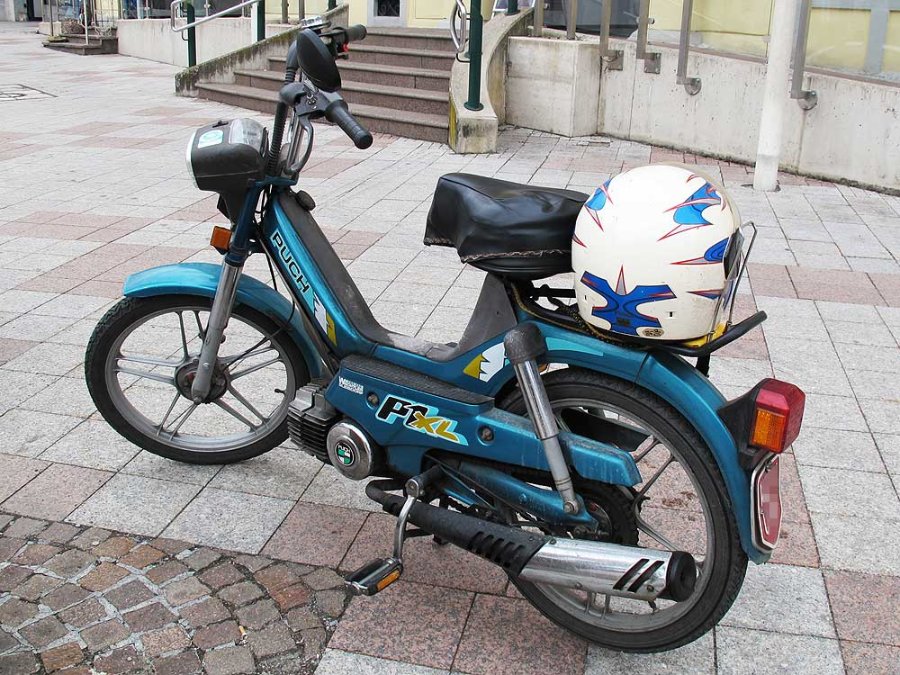
Until 1974 the law filed a moped under motorcycle, and a motorcycle needed foot brakes, turn signals and other hardware that a pedal-start fifty never carried. After a heavy lobbying push by the industry, the federal government relaxed its safety standards that year. The states did the rest, and they did it unevenly. Top speed was capped between 20 and 30 mph, major highways were off limits, and many states asked for no license, no insurance and no registration. Some set no minimum age at all. The paperwork asked for almost nothing, and the sales numbers show what happened next.
Sales went from 25,000 in 1975 to 75,000 in 1976 to 150,000 in 1977, then doubled again in 1978, the year Honda brought the Hobbit. Puch, Garelli, Batavus and Tomos were already on the showroom floor. A good one cost about 350 dollars, and the full range ran from 300 to 900. Government planners expected two to three million mopeds on American roads during the 1980s. President Carter pushed them as part of his energy conservation program, and high schools taught Moped Ed.
The pitch was arithmetic. A moped made 1 to 2 horsepower and returned 120 mpg and up. Half of all car trips carried a single occupant, and four of five were under 10 miles. A rider covering 12 miles a day instead of driving saved about 240 gallons a year and paid off the bike in two years. By July 1980 a Honda car dealer on the Massachusetts South Shore had watched moped sales climb 300 percent in two years, against 60 percent for motorcycles. Meter readers in North Reading, Massachusetts, and Mount Vernon, Illinois, rode them to work, a police department in Rehoboth, Delaware, used them for crowd control, and roughly one buyer in five was a woman. Thieves cleaned out a Quincy bicycle store that sold Puch and Batavus twice, and the owner went to chains and padlocks.
No single event did. Thirty miles an hour felt slow in mixed traffic, and the crawl away from a stoplight felt worse. Accidents brought helmet requirements. Police worried about drivers with revoked car licenses switching to a moped, which needed no license in many states, and legislators answered with sharply tighter rules. Distance worked against the machine as well: a 20-mile commute takes about an hour, longer with hills.
The mood turned too. Three Mile Island, the oil crunch, the hostage crisis and the invasion of Afghanistan had made small look beautiful, and a new decade wanted bigger. The novelty wore off and the moped came to look wimpy. Sales leveled, fell, and dropped off the map.
Fewer than a dozen dealers in the entire country, from a late-1970s peak of several hundred. The Moped Association of America closed its doors. Elsewhere the machine never lost its place: by 1980 France alone had 7 million mopeds on its roads, a number the American dealer network never came near.
A Puch, Tomos or Batavus bought new in 1979 was serviced by a dealer who was likely selling something else by 1985. If you find one with the original dealer sticker, keep it. It marks one of the several hundred stores that built the boom, and nearly all of them are gone.
Meet the Puch Maxi that sold through the boom, then pick up something for the garage wall or the rider.
Related: Yamaha QT50 Yamahopper: the 95-pound shaft-drive runabout with no pedals See also Tomos after 1980
General information from published sources and owner experience. Your bike, your state and your tools may differ, so check your own service manual and local rules. Moped Motel is an independent fan site, not a repair service. No seller, brand or channel mentioned here paid to be included or asked to be, and we have no affiliation with any of them.
More guides are on the Moped Wrench Guides page, with the sources. Want to meet the riders? See Feature Your Bike.
T-Shirts, hats, and customs. Checkout happens on Etsy.
Moped Motel is vintage two-stroke moped apparel. We print over 100 moped designs on t-shirts, long sleeves, hoodies, sweatshirts, hats and beanies, inspired by real Puch, Tomos and other classic mopeds. Everything is printed to order, and checkout is on Etsy.
// MOPED ARCADE
Name That Moped, Pinball, Blackjack and Stack. Free to play.
Play now