Moped Wrench Guides · Piaggio Ciao
The Piaggio Ciao is a 49 cc air-cooled two-stroke moped that Piaggio introduced in 1967 and kept building until 2006. Over those years the name covered a run of different bikes, and owners label them in different ways, so two people can ask the same question and get different answers. This guide sorts the names by what you can see on the bike.
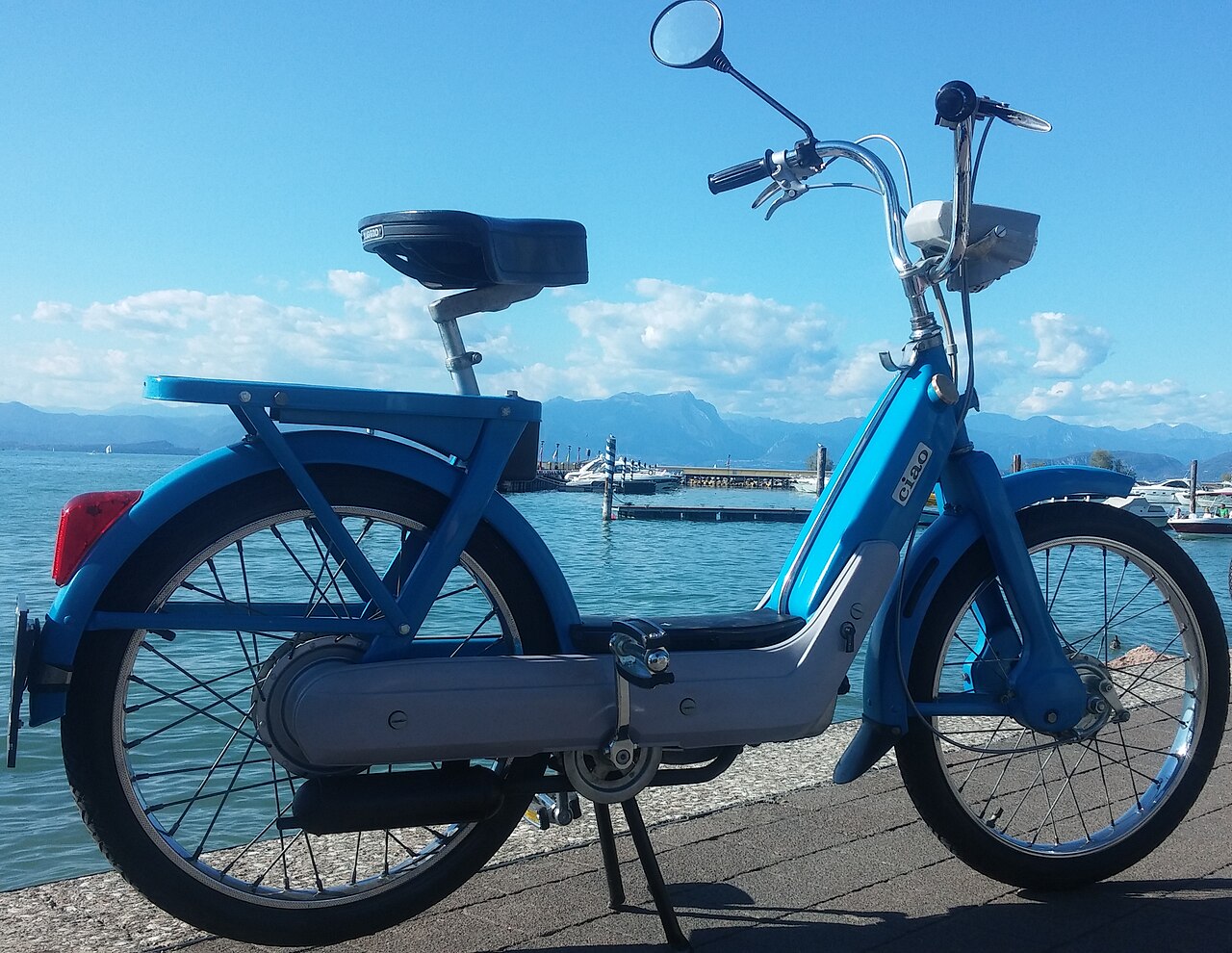
Start with the saddle, the rack and the front end. The Ciao sorts into SC, L, P, Px and Mix, and every difference is visible from across the garage: round or square luggage rack, a saddle on a suspension seatpost or not, the taillight on the rear fender or on the rack, racks fixed or removable. US bikes use another scheme: Base, Supreme and a Deluxe with turn signals. Italian listings use a third.
| Name | What it looks like |
|---|---|
| SC | Round rack, saddle on a suspension seatpost, taillight on the rear fender, fixed racks, chrome fenders |
| L | Square rack, semi-suspension saddle, taillight on the rear fender, removable racks |
| P | Square rack, semi-suspension saddle, taillight on the rack, removable racks |
| Px | Round rack, suspension seatpost, taillight on the rack, fixed racks |
| Mix | Like the Px, with the oil tank in the rack |
| Base | Rigid front and rear |
| Supreme | Leading-link front, spring at the seatpost |
| Deluxe | Supreme plus turn signals, with a 6 V battery in boxes on the rack |
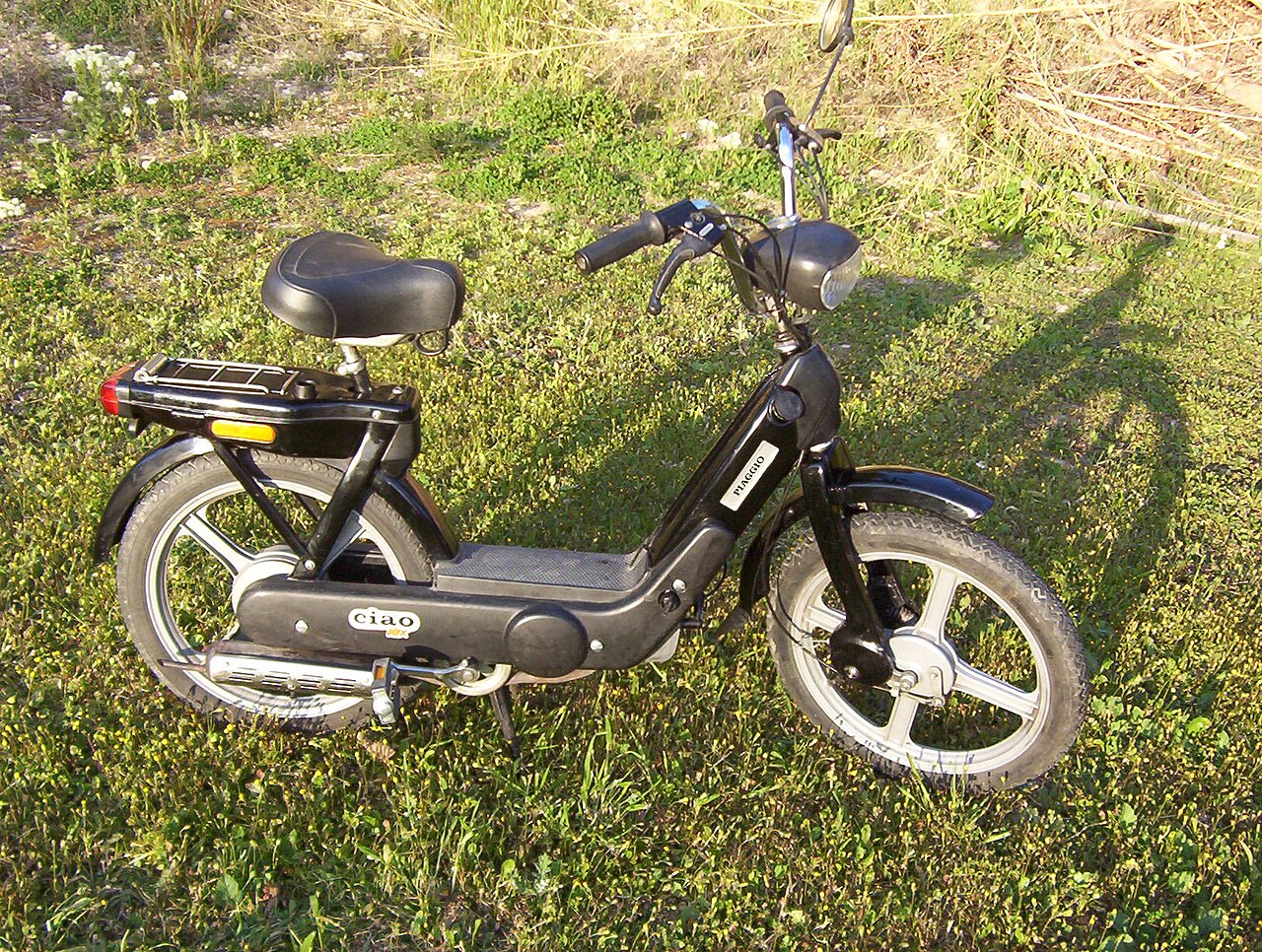
The 1979 to 1996 bikes split into P, PX, PV and PXV. The PX has the sprung SC-style saddle, the PV has the Variomatic transmission, and the PXV has both. The sub-series that followed were the first series from 1979 to 1986, then Ecology System, FL, FL2 and FL3, which ran to 1996.
Later bikes are easier to spot. The Teen (1988 to 1999) has 16-inch alloy wheels and a two-tone body. The Mix (1996 to 1999) has an automatic oil mixer with the oil tank in the rear rack. The Kat Euro 1 and Kat Euro 2 bikes (1999 to 2006) are the catalytic versions. Insella says the engine was adapted to Euro 1 in 1991 and updated again in 2003, which does not line up with the Kat dates above. The two pages may be describing different changes.
Look for the V in the name first. The PV and PXV have the Variomatic, and not every Ciao has the automatic CVT. The variator version has more punch and costs more, and pedalling helps on hills. The variator is a clutch assembly with centrifugal weights, a V-belt, a counter-pressure spring and a matching torque converter, and weights run from 6 g to 14 g.
Belts are model-specific. The original Ciao belt is 963 mm and 12.9 mm wide, inside a Ciao range of 950 to 978 mm, against 1050 to 1060 mm for the Bravo and 1128 to 1150 mm for the Si. A 978 mm belt and a 950 mm belt can sit under the same Piaggio part number, and a parts catalog is not a factory table. Measure the belt you take off before you order. The job itself is in the Ciao belt and clutch guide.
| Item | Figure |
|---|---|
| Engine | 49 cc, single-cylinder two-stroke, cooled by a fan on the flywheel magneto |
| Displacement | 49.77 cc |
| Bore and stroke | 38.4 x 43 mm |
| Fuel mix | 2 percent oil, 50 to 1 |
| Carburetor | Dell'Orto SHA 12/12 or 12/10; 12:7 is also fitted |
| Weight | About 40 kg dry |
| Tank | 2.8 L in the frame with a 0.5 L reserve |
Pedals start the engine and double as footrests. A short lever on the handlebar lifts a decompression valve in the head, and that lever is also how you stop the engine, because there is no kill button. If the tank runs dry, a pin in the rear hub frees the wheel so you can pedal home.
They share parts but they are different bikes. The Si engine was derived from the Ciao and differs mainly in the cylinder head and cooling fins. The Si also has a telescopic fork, a rear monoshock, different lights, a longer saddle and four-spoke wheels. The Boxer ran from 1969 to 1983 and the Bravo from 1973 to 2001; the Bravo has a telescopic fork and twin rear shocks. The Boss (1988 to 1989) added a kickstart, a mass button and a speedometer, and the Grillo has a 14-inch wheel. Several variator parts fit the Ciao, Si, Bravo and Boxer together, but belts differ by model.
A US Ciao from before 1978 carries a Ciao emblem on the side of the tank and a Vespa sticker on the rear side covers. Later US bikes have Vespa and Piaggio lettering down the tank and Ciao lettering on the plastic side covers. The bike was sold in Canada in the 1970s as the Vespa Ciao.
Find your Ciao, then pick up something for the garage wall or the rider.
Related: Piaggio Ciao engine: single-speed or variator, and how to tell which one you have.
General information from published sources and owner experience. Your bike, your state and your tools may differ, so check your own service manual and local rules. Moped Motel is an independent fan site, not a repair service. No seller, brand or channel mentioned here paid to be included or asked to be, and we have no affiliation with any of them.
More guides are on the Moped Wrench Guides page, with the sources. Want to meet the riders? See Feature Your Bike.

T-Shirts, hats, and customs. Checkout happens on Etsy.
Moped Motel is vintage two-stroke moped apparel. We print over 100 moped designs on t-shirts, long sleeves, hoodies, sweatshirts, hats and beanies, inspired by real Puch, Tomos and other classic mopeds. Everything is printed to order, and checkout is on Etsy.
// MOPED ARCADE
Name That Moped, Pinball, Blackjack and Stack. Free to play.
Play now