Engines of Note · The 50 cc rule
The 50 cc moped was never an engineering decision. It was a paperwork category, and the paper has dates. Every cylinder you have ever torqued down was sized to fit a form.
A French circular dated May 1926 created the bicyclette à moteur auxiliaire. Under 100 cc, under 30 kg, under 30 km/h, and it had to have pedals. Meet those four numbers and the rider needed no registration, no licence, no test and no tax, and could start at 14. The pedals were the price of admission. That is why a machine built to be ridden by its motor still carries a bicycle crank.
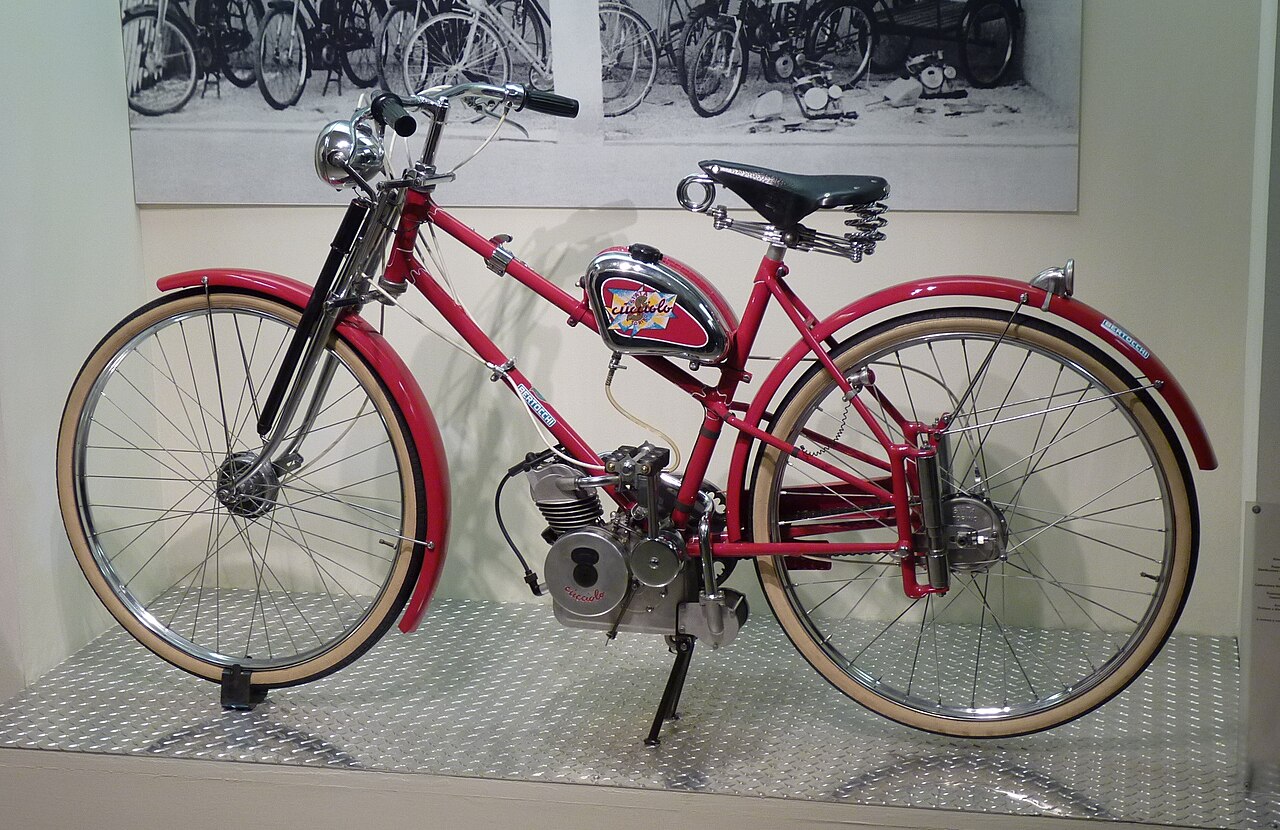
A Vichy decree of 5 June 1943 cut the old class into three: motorcycles above 125 cc, the velomoteur from 50 to 125 cc, and below 50 cc the machine France came to call the cyclomoteur. The record does not say why the line fell at 50, and anyone who offers a tidy reason is guessing. In Turin, in 1944, the Cucciolo appeared: a 48 cc engine bolted into a bicycle. The word moped followed in 1952, coined by the Swedish journalist Harald Nielsen from motor and pedaler.
Peugeot launched its 98 cc bicycle motor in 1931, priced between 1,150 and 1,475 francs. To meet the 30 km/h cap, a control plate shrank the 16 mm Gurtner intake to 10.6 mm. The two-speed P51 of 1932 had no restrictor, an Amal carburettor and pedals that swung down into footrests. A modern test of one measured 23 to 24 mph flat out against a legal limit of 18.6 mph.
The trick never died. Italian, French and Swedish makers sold machines that ran at more than twice the legal speed, with a throttle restriction a rider could pull in minutes. A Finnish survey put the average top speed of school-age mopeds at 72 km/h against a legal 45.
| Country | Class | Speed limit | Minimum age |
|---|---|---|---|
| Germany | Mofa | 25 km/h | 15 |
| Germany | Moped | 45 km/h | 16 |
| Netherlands | Snorfiets, blue plate | 25 km/h | 16 |
| Netherlands | Bromfiets, yellow plate | 45 km/h | 16 |
| Switzerland | Mofa, category M | 30 km/h | 14 |
| Italy | Ciclomotore | 45 km/h | 14 |
| Japan | 50 cc or 0.6 kW | 30 km/h | 16 |
France changed the rules inside its own borders. A decree of January 1980 banned geared mopeds, which is why French bikes of that era run a single speed. The pedal requirement ended in July 1983. In Britain, a 1971 law kept 16-year-olds off anything above 50 cc, and from 1972 Honda, Yamaha, Suzuki, Puch, Fantic, Gilera, Gitane and Garelli sold 50 cc sports bikes with pedals bolted on to keep them legal. The Yamaha FS1-E is the famous one. By 1977 the British cap was 30 mph and 250 kg.
In February 1974 Motobecane, Peugeot and Sinfac, the maker of the Solex, petitioned the federal safety agency for a moped category of their own. The agency refused. In October 1974 it created a motor-driven cycle instead: 5 brake horsepower or less. A bike that cannot reach 30 mph in a mile does not need turn signals. By 1977 about 30 states had written their own moped class, typically 50 cc and 30 mph, a few at 20 or 25. Kansas allows up to 130 cc. More than 250,000 Americans owned a moped that year.
Check your state's definition before you buy a big-bore kit. Where the line is 50 cc, a bored-out cylinder can push the bike out of the moped class and into the motorcycle one. In Europe, tuning past the limit usually means re-registering as a motorcycle, with a higher licence, tax, insurance and minimum age. Keep the pedals. The law wrote them in, and they are the reason the engine in your frame exists.
Related: Pedals as paperwork: the 1971 law that built the Fizzy, the British side of the pedal rule., The German Mofa and its 25 km/h paper trail
Find your bike, then pick up something for the garage wall or the rider.
Related: The Peugeot 103 in Morocco.
General information from published sources and owner experience. Your bike, your state and your tools may differ, so check your own service manual and local rules. Moped Motel is an independent fan site, not a repair service. No seller, brand or channel mentioned here paid to be included or asked to be, and we have no affiliation with any of them.
More guides are on the Moped Wrench Guides page, with the sources. Want to meet the riders? See Feature Your Bike.
T-Shirts, hats, and customs. Checkout happens on Etsy.
Moped Motel is vintage two-stroke moped apparel. We print over 100 moped designs on t-shirts, long sleeves, hoodies, sweatshirts, hats and beanies, inspired by real Puch, Tomos and other classic mopeds. Everything is printed to order, and checkout is on Etsy.
// MOPED ARCADE
Name That Moped, Pinball, Blackjack and Stack. Free to play.
Play now